
When I was pregnant, Robby and I attended an infant CPR course. We took all the information to heart and have been careful to keep small toys, tools, coins, and batteries out of reach. We’ve also cut up thousands of sandwiches and apples to reduce the likelihood of our son choking on food. Fortunately, we’ve avoided a major choking incident.
I say fortunately because choking is not uncommon, especially among young children who like to explore the world by putting anything and everything in their mouths. Here are some sobering stats:
- – At least 3 children choke to death on food or other objects around the world each day
- – 1 child dies from choking in the US every five days
- – Over 12,000 children visit an ER in the US because of food-related choking every year
- – There were 4,500 deaths (among all ages) due to choking in the US in 2009 alone
- – Approximately 95% of deaths from choking occur in the home environment
- – Choking is a leading cause of death in persons over 65
The DontChoke website (a BC Children’s Hospital/ UBC Initiative) is a great resource on choking. Along with the stats noted above, the site also provides a list of common choking hazards. They state the most common obstructions worldwide are fishbones, coins, nuts, and seeds. Other items include hard candies and gel candies, unpopped popcorn kernels, and even stickers. One item of particular concern is the button battery; not only can it obstruct the airway, but the acids in it can burn a hole through the esophagus in two hours.
So what do you do if your spouse or child starts to choke? According to the experts like Red Cross, if the person is able to cough, talk, or breathe in and out, then don’t intervene. Watch him carefully to make sure he’s still breathing and let him cough up the obstruction. (That’s what coughing is for.)
However, if the person becomes unable to cough, talk, or breathe and starts turning blue, then back slaps and the Heimlich maneuver are in order. The Heimlich manuever is a fancy name for abdominal thrusts. These thrusts lift the diaphragm and expel air from the lungs, causing the foreign object to be expelled. The idea is simple, but there are special considerations for those who are infants, unconscious, pregnant, infirm, or disabled. Therefore, it’s very important to learn the details and to take an in-person class if possible. Healthline.com has a good description of the Heimlich manuever, including those special considerations, and provides training videos. Check with the Red Cross or your local hospital for hands-on training.
But here’s the crux: the Heimlich is NOT always effective. CPRCertified.com states the Heimlich “has an extremely high success rate, among children and adults alike; according to an AHA report, approximately 70-86% of choking victims recovered after receiving the Heimlich maneuver.”
That means 24-30% of victims do NOT recover. To me—a mama of a rambunctious toddler who loves small trucks and raisins—that is a scary statistic! And what do you turn to if the Heimlich doesn’t work? Well, experts say to keep trying it and to call 911. Maybe their techs will have more luck, or maybe they’ll need to give your kid a tracheotomy. Still scary.
The Backup Devices
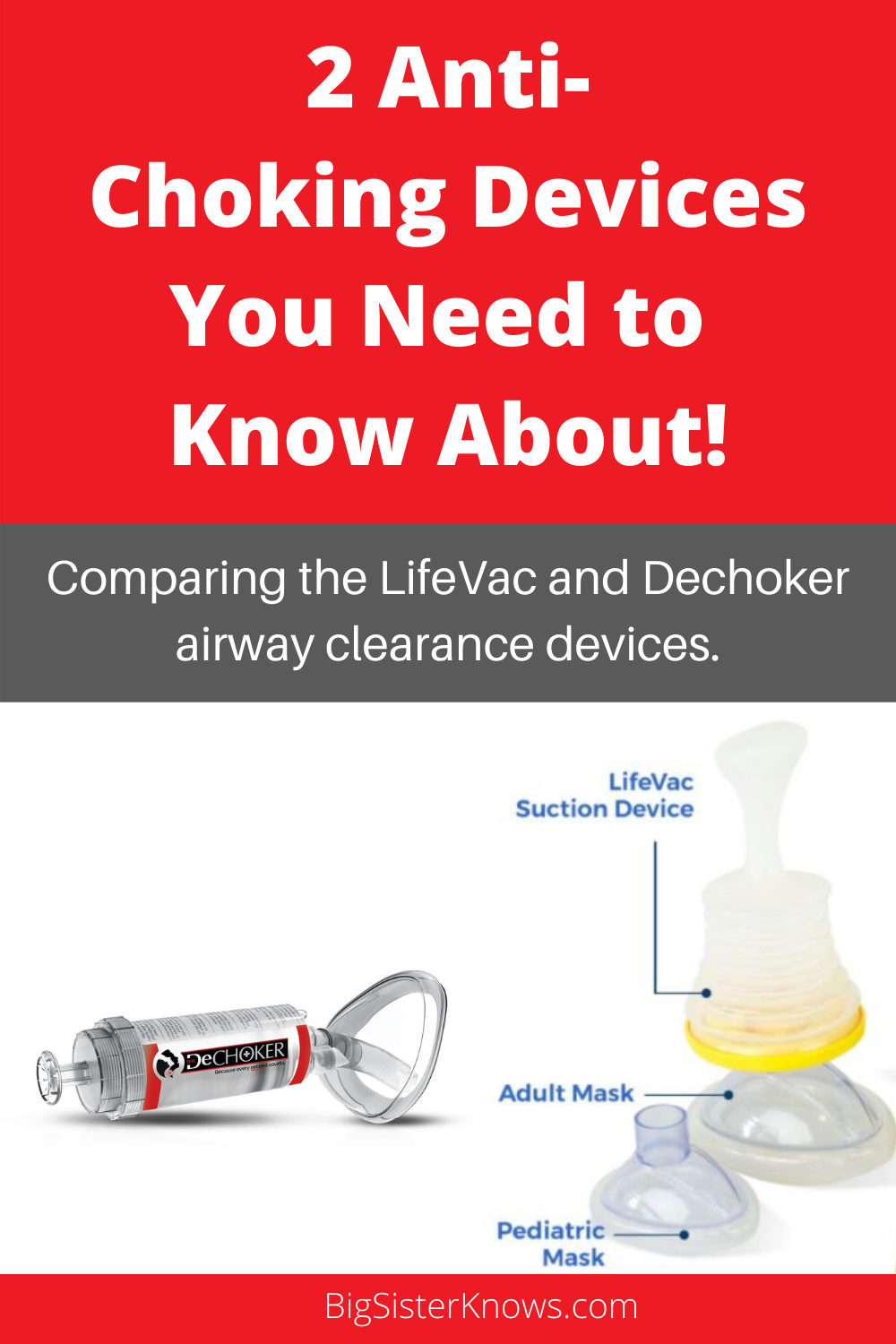
That’s why I was so relieved when I recently discovered two airway clearing devices: he LifeVac and the Dechoker. These are relatively new products—on the market only a few years—so most people I’ve talked to have never heard of them. Now I’m now on a mission to make sure everyone knows about these life-saving devices!
The LifeVac and Dechoker have different designs, but both of the devices
- – are designed to be used if the Heimlich and back slaps prove unsuccessful;
- – can be used on adults, children, or yourself, when using the appropriate size face mask; and
- – are registered with the FDA as medical devices.
These devices have made headways within in the medical community and are now provided in some schools and nursing homes.
Here’s a breakdown of the two devices.
LifeVac – 122 Lives Saved
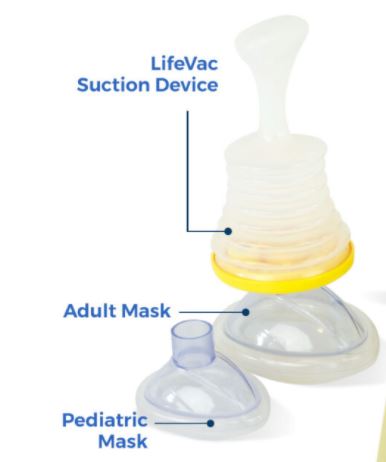

If you’re the one choking, you should be able to easily assemble the device and use it on yourself.
The pediatric mask is recommended for children who weigh at least 22 pounds. However, the manufacturer notes on their website that parents have used their device on smaller infants with success.
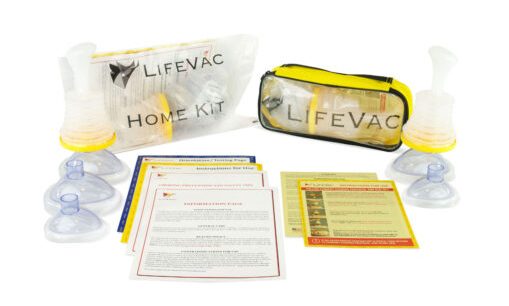

The LifeVac device (the plunger with handle) does not expire but the masks should be replaced every 2-3 years. This product is made in the USA.
Special Offer: Currently, if you purchase the Home Kit for $69.95, you can add a Travel Kit for $49.
Dechoker – 154 lives saved!


You can use the Dechoker on yourself if you’re the one choking.
Unlike the LifeVac, the Dechoker has an integrated mask, which means you won’t need to place the mask on the device during an emergency. However, if you want to protect your spouse and your children, you might need to purchase three devices—sized for adults, children, and toddlers (for children 12 months and older).
The Dechoker expires after 27 months, so you’ll need to reorder it every couple years.
Special Offer: Right now, can you buy one Dechoker at any size for $49.95 (on sale from $69.95), a two pack for $99 (from $139), or a three pack for $139.95 (from $209.85).
The Heimlich is not always effective! Get an airway clearance device like the LifeVac or Dechoker to protect yourself and your family today. #firstaid Share on XYou never know when a choking emergency will happen, and if it does, the Heimlich may not be sufficient. That’s why I now have one of these devices on the fridge and one in each car. Our parents were just as excited to get theirs, as well.
Please consider purchasing one of these airway clearance devices for yourself, your parents, your grandmother’s nursing home, and your child’s daycare facility. It could even make a great Mother’s Day gift! Let your friends and family know about these devices so they can be prepared, too.
Have you purchased one of these airway clearance devices? What do you think of them? Have you had to use one during an emergency? I’d love to hear from you, so leave a comment below.
Pin it for Later