Have you ever started heating oil in a pan and then got distracted? If so, you probably realized your error once your pan started smoking. That happens whenever oil is heated at or above its “smoke point.”
An oil’s smoke point is the temperature at which the oil begins to break down chemically, causing it to smoke. While this decomposition is a natural process, it generates toxic fumes and free radicals which are extremely harmful, whether inhaled or ingested.
One of the main reasons that oil is refined, or processed, is to raise its smoke point so it can be used for higher-temperature cooking. This means that different oils should be used for different temperatures.
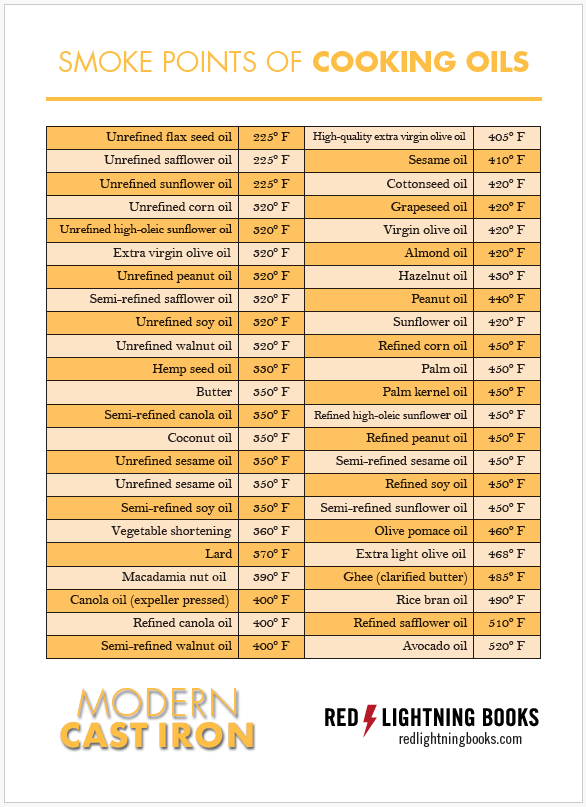
To identify the smoke point of an oil, you can check the back label. Some oils will indicate whether they can be eaten directly on salads (not heated at all) or used for high-heat cooking. However, to determine the exact smoke point, you may need to do a quick internet search. OR you can reference this handy chart from my book, Modern Cast Iron. This chart includes common (and some not-so-common) oils, in order of their smoke points. (Click to download a printable version.)
Oils for Cooking
To keep your oil from smoking on the stove top, start the temperature at low-medium and then turn up the heat as needed. You should also choose an oil with a smoke point that is appropriate for your method of cooking.
For example, coconut oil is great for mid-temperature cooking, while avocado oil can handle the higher temperatures needed for searing meats. If you want the flavor of butter, its low smoke point of 350° F limits its usage. However, clarified butter (ghee), which has the milk solids removed, has a smoke point of 485° F. This makes it a yummy option for sautéing veggies and searing meats.
You may also want to consider the cost involved. For example, avocado oil would be ideal for frying because it has the highest smoke point in our list; however, it can be quite expensive. For this reason, a lot of cooks use budget-friendly canola or extra light olive oil.
Oils for Seasoning
You can’t talk about restoring cast iron without talking about smoke points. That’s because the seasoning on a cast-iron pan is created by coating the pan in oil and then heating it for an hour. The temperature at which you heat the pan is dependent on the oil’s smoke point.
Flaxseed oil is sometimes recommended because its high level of omega-3 fatty acids creates a stronger nonstick coating. However, flaxseed oil has the lowest smoke point of 225° F. This means you’ll need to keep the temperature relatively low during the seasoning process. Flaxseed oil can also be quite expensive, which may knock it out of your budget.
Most restorers use olive oil or Crisco to season their pans. Another good option I like is Crisbee. (Watch my interview with Crisbee to learn why.) No matter which oil you choose, determine the smoke point and then bake the pan about 10-20 degrees under the smoke point to avoid those fumes.
Here are some other articles you may be interested in:
Which Oil Should You Use to Season Your Cast-Iron Skillet?
How to Clean & Season Your Cast-Iron Skillet?
3 Lies Your Grandma Told You About Cast Iron
Pin it for Later:

Get a copy for Father’s Day